


 he successful design of commodity magnetic sensors requires an understanding
of the fundamental magnetic properties of the materials used in their fabrication.
This article describes a few of the types of magnetic materials commonly
encountered, their properties, and the manner in which they are used.
he successful design of commodity magnetic sensors requires an understanding
of the fundamental magnetic properties of the materials used in their fabrication.
This article describes a few of the types of magnetic materials commonly
encountered, their properties, and the manner in which they are used.
While most, if not all materials have some measurable electromagnetic interactions, we are looking at those that fall into the following categories:
- Hard magnetic materials
- Soft magnetic materials
- Electrical conductors
Ferrites: Low magnetic flux; low cost; commonly mixed with plastic binder to make "refrigerator magnet" strips
Alnico: Moderate cost; low to moderate flux, depending on grade; can be used at high (>200ºC) temperataures; wide variety of magnetic properties in various grades makes it very useful in sensor applications
NdFeB (neodymium-iron-boron): Moderate cost; high flux; limited temperature operation (<150ºC); corrodes very easily
SmCo (samarium-cobalt): High cost;
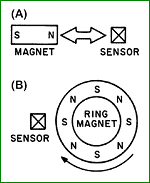 |
Hard magnetic materials are typically used in either of two ways in sensor applications. The first is as an actuator magnet. In this operating mode, the actuator magnet itself is the sensor's target of interest. This approach to sensing (proximity of a magnet) is useful mainly because strong magnetic fields (>200-300 G) do not commonly occur in nature nor are they typically produced by accident. Figure 1 shows these materials being used in linear and rotary modes.
The linear actuation mode is commonly used in proximity devices to detect whether the magnet is sufficiently close to the sensor. The rotary actuation mode is typically used to measure the speed of the object to which the ring magnet is affixed.
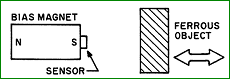 |
The second way in which hard magnetic materials are used is to provide a bias field in the sensor assembly. This bias field interacts with the object being sensed (typically made of a soft magnetic material such as steel), and a sensor element detects the changes in the bias field caused by this interaction.
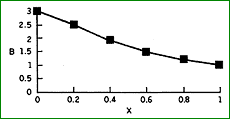
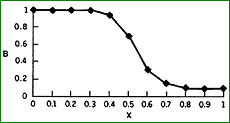
Figure 2 shows a simple ferrous article proximity detector made in this way. The flux measured at the pole face of the bias magnet
 |
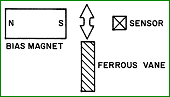
Another common bias-magnet sensor architecture is the vane interrupter (see Figure 4). Here, a ferrous vane interrupts the flux path between
 |
 |
- Flux guides
- Shields
- Sensor elements using nonlinear effects
Flux guides are useful in magnetic sensors because they allow the designer to channel magnetic flux in a more arbitrarty manner than that provided by free space. This provides two major benefits. The first is that the designer
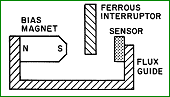 |
Figure 6 shows how a flux guide can be used in the design of a vane interruptor. In this example, the addition of a flux guide increases the available flux (as measured by the sensor) over that which would be
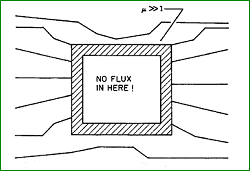 |
Shields are another common application of soft magnetic materials. While magnetic flux lines can't be stopped dead (they form closed loops), they can be shunted around a region in which they are not desired (see Figure 7). Multiple layers of shielding can be arranged in a nested pattern to provide even more effective shielding.
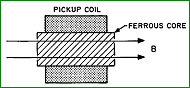
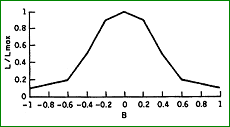
Finally, nonlinear effects of soft magnetic materials can be exploited
 |
 |
 |
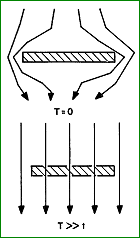 |
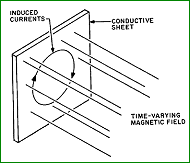
The applicability of eddy current effects to the design of transformers and RF systems has long been recognized, but is often ignored in the design of commodity sensors where magnetic fields are often assumed to behave "instantaneously." Knowledge of these effects, however, becomes more and more important as dynamic performance requirements increase, such as in automobile ignition timing systems, where frequency response in the 10 kHz range is now becoming necessary.
Summary
Adapted from a paper presented at Materials Week, sponsored by ASM International-TMS, 7-10 October 1996, Cincinnati, Ohio.